

Report on the 12th Remsons International Research Conference (RIRC) 2026
Theme: “Implications of Artificial Intelligence in Contemporary Businesses”
Date: 29 August 2026
Organised by: Durgadevi Saraf Institute of Management Studies (DSIMS) and Durgadevi Saraf Global Business School (DSGS)
Under the aegis of: Remsons Centre for Management Research (RCMR)
Durgadevi Saraf Institute of Management Studies (DSIMS) and Durgadevi Saraf Global Business School (DSGS) organised the 12th Remsons International Research Conference (RIRC) 2026 on 29 August 2026, under the aegis of the Remsons Centre for Management Research (RCMR).
The conference was organised around the contemporary and highly relevant theme, “Implications of Artificial Intelligence in Contemporary Businesses.” The conference provided a platform for academicians, researchers, industry professionals, practitioners and students to present their research, exchange ideas and deliberate upon the opportunities and challenges emerging from the rapid adoption of Artificial Intelligence (AI) in business.
The conference theme was particularly significant in view of the growing influence of AI on business strategy, decision-making, marketing, finance, human resources, operations, supply chains, customer experience and innovation. The conference brochure highlighted the need to examine not only the opportunities created by AI, but also concerns relating to ethical use, workforce transformation, data privacy, governance and regulatory frameworks. The conference therefore sought to encourage responsible and sustainable approaches to AI adoption in contemporary business environments.
Research Participation and Paper Submissions
The conference received an encouraging response from the research community. A total of 25 abstracts were received, out of which 18 full research papers were submitted. Following the screening and review process, 14 papers were presented during the conference through online and offline presentation modes.
The presented research papers reflected diverse perspectives on the application and implications of AI across different sectors and business functions. The conference also witnessed participation from in-house faculty members, with three papers submitted and presented by DSIMS/DSGS faculty members. These included Shital Patil, who presented one paper, and Kitty Rana, who presented two papers. Their participation strengthened the institution's research culture and demonstrated the active involvement of faculty members in contemporary research themes.
The conference was structured to encourage research contributions from different categories of participants. The conference framework included separate Student/Research Scholar and Faculty/Corporate presentation tracks, thereby providing opportunities for both emerging researchers and experienced academicians and professionals to contribute to the academic discourse.
Inaugural Session and Address by the Chief Patron
The conference was graced by Shri Ashok M. Saraf, President, RSET and Chairman, DSIMS & DSGS, as the Chief Patron. In his address, Shri Saraf apprised the audience about the origin and development of the Remsons Centre for Management Research (RCMR). He recalled that RCMR was established through the magnanimous donation of the late Shri Vishwaprakashji Harlalka, Chairman of the Remsons Group, who envisioned the establishment of a dedicated centre for management research.
He expressed appreciation for the continued support extended by Shri Krishna Kejriwal, Chairman and Managing Director, Remsons Industries Ltd., towards RCMR. He also highlighted the longstanding contribution of RSET to education and its role in shaping more than 60,000 students. He informed the audience about the institution's future plans, including the proposed establishment of a Skill Tech University at the Malad Campus.
Speaking on the conference theme, Shri Saraf observed that Artificial Intelligence has moved beyond being a distant technological concept and has become an important force influencing the manner in which organisations operate, compete, innovate, make decisions and serve their stakeholders. He emphasised that AI should augment human potential rather than diminish human responsibility. He encouraged researchers to use the conference as an opportunity to learn, question, collaborate and build meaningful professional and academic relationships.
Inaugural Address by the Chief Guest
The inaugural address was delivered by Mr. Rohit Darji, Company Secretary & Compliance Officer and General Manager – Legal & Finance, Remsons Industries Ltd. His address focused on the relevance of research and the contribution of Remsons to management research. His participation provided an important industry perspective and reinforced the conference's emphasis on connecting academic research with contemporary business practices.
RCMR Report
Dr. Sumana Chaudhuri, Chief Convener, RIRC 2026 and Assistant Dean (Research), presented the report of the Remsons Centre for Management Research for 2025–26. She highlighted the significant research contributions made by the Institute's faculty members and noted their publications in journals of national and international repute, including journals indexed in Scopus and ABDC.
She further informed the audience that since January 2026, faculty members had published six research papers, including three papers authored by Dr. Sumana Chaudhuri in high-impact, Scopus-indexed international journals. She also highlighted the publication of Volume 8, Issue 1 of The Management Quest, the Institute's ISSN-indexed bi-annual research journal, comprising six peer-reviewed research papers.
The conference brochure identifies The Management Quest as an important publication avenue for outstanding conference papers, while selected papers are also considered for inclusion in the Conference Proceedings carrying ISBN 978-93-5196-952-5.
Keynote Address
The Guest of Honour, Mr. Rajarama Rao Bannengala, Founder and Managing Director, ProPMO Services Pvt. Ltd., delivered the keynote address on “Beyond Working Smart: The AI Wave and the Future of Business, Work and Human Capability.”
Mr. Bannengala discussed how AI has evolved from an emerging technology into a significant force influencing contemporary business and professional life. Drawing parallels with successive industrial revolutions, he explained how AI is transforming the ways in which organisations create value, make decisions, compete and utilise human capabilities.
The keynote explored the changing relationship between businesses, professionals and intelligent systems, with emphasis on organisational structures, competitive advantage, workforce expectations and the changing meaning of “working smart.” He highlighted the importance of adapting leadership approaches, workplace practices and academic frameworks to navigate the AI-driven transformation responsibly. His address concluded with a pragmatic perspective on responsible AI adoption and its potential to contribute to a more productive, adaptable and purposeful future.
Research Paper Presentation Sessions
The keynote was followed by online and offline research paper presentation sessions. The papers covered a wide range of contemporary business issues, including AI-enabled marketing and customer engagement, financial markets, auditing, e-commerce, FinTech, hospitality, smart cities, employment, logistics and business innovation.
Among the papers presented were studies on AI chatbots in management libraries, AI-powered personalisation in fashion retail, intraday implied volatility and expiry-day surveillance, AI and automation in auditing, buyback announcements and share prices, AI-driven personalisation and impulse buying in Indian e-commerce, logistics cost performance in international supply chains, innovation in the Lego business model, AI-driven FinTech adoption among small retailers, AI and chatbots in hotel guest services, platform urbanism and algorithms in smart cities, and the impact of AI and automation on jobs.
The diversity of topics demonstrated the interdisciplinary nature of AI research and its growing relevance across different industries and functional areas.
Evaluation and Academic Feedback
The research papers were evaluated through a preliminary screening and peer-review process, followed by assessment by the Session Chair. Prof. Dr. Krupa Rai, Associate Professor at KJ Somaiya Institute of Management Studies & Research, Mumbai, served as the Session Chair and expert reviewer.
Following the presentations, Dr. Rai shared observations, constructive feedback and suggestions with the researchers. She emphasised the importance of academic rigour, clear theoretical foundations, logical reasoning and sound research methodology. She also advised researchers to exercise caution and discretion while using Generative AI in research manuscripts, stressing that AI should complement rather than replace the researcher's own critical thinking and scholarly judgement.
Best Paper Awards and Recognition
The conference included Best Paper Awards in both the Professional and Student Tracks. The papers were assessed through blind review and evaluation by the Session Chair.
In the Professional Track, Rahul Parchure and Bernadette D'Silva received the First Best Paper Award for their study on AI and chatbots in guest services and employee attrition in five-star hotels in Mumbai, along with a cash prize of ₹8,000.
Harsh Thakrar and Raghukumari P. S. received the Second Best Paper Award for their paper on intraday implied volatility and expiry-day surveillance in India.
Ar. Mildred Jose received the Third Best Paper Award for her research on algorithms within smart cities, along with a cash prize of ₹4,000.
In the Student Track, Vikram Joshi and Kitty Rana received the Best Paper Award, along with a cash prize of ₹5,000, for their research on the impact of buyback announcements on share prices.
Shubham Chaurasiya, Maroof Khan and Anuj Pandey, et al. received the Second Best Paper Award, with a cash prize of ₹2,000, for their research on AI-driven personalisation and impulse buying in contemporary Indian e-commerce.
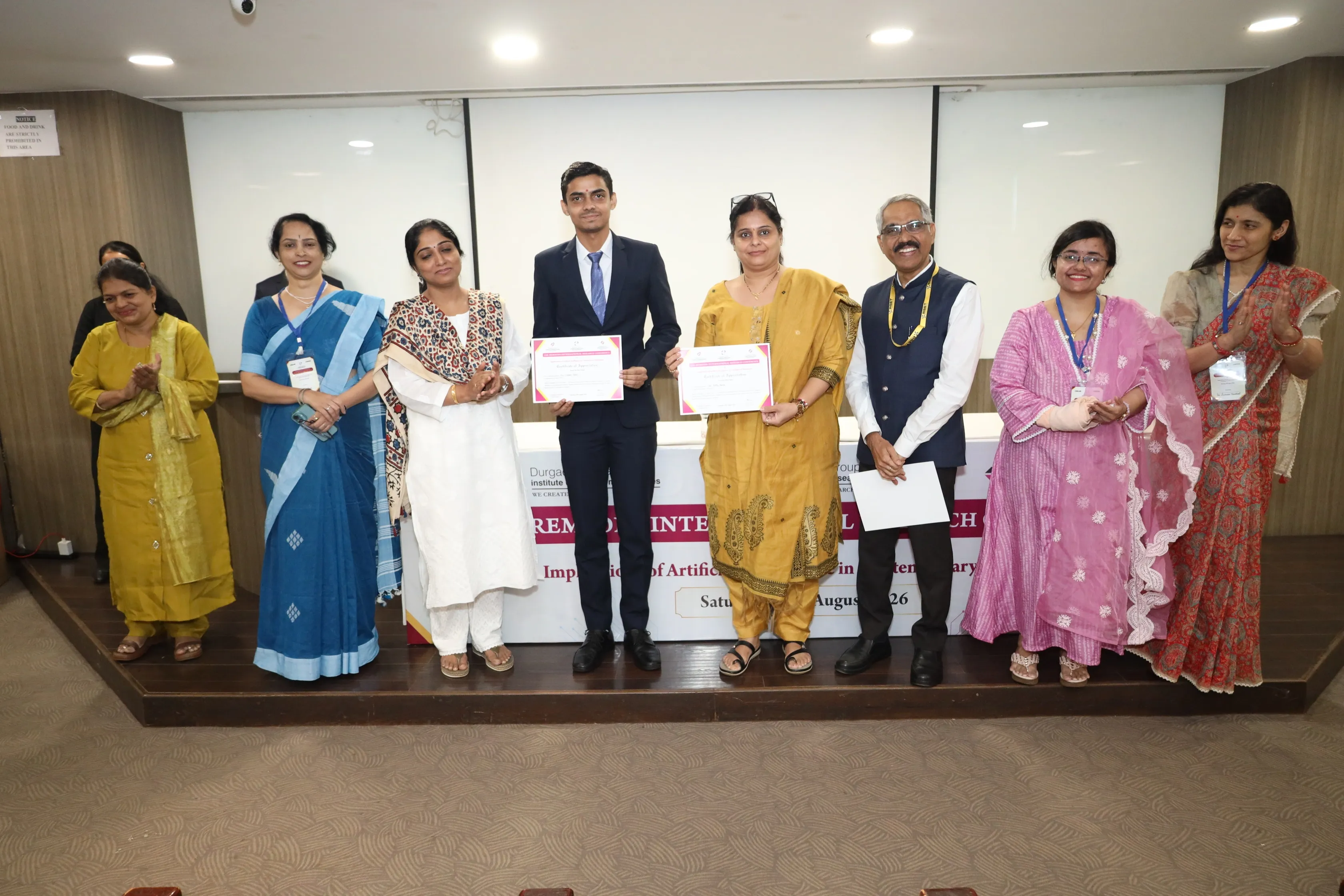
Certificates of participation and presentation were awarded to the paper presenters in recognition of their contributions. Award-winning papers are subject to the journal's editorial and publication processes and may be considered for publication in Volume 8, Issue 2 of The Management Quest.
Conclusion
The 12th Remsons International Research Conference 2026 provided a meaningful platform for academicians, researchers, industry professionals and students to exchange knowledge and examine the rapidly evolving role of Artificial Intelligence in contemporary businesses. With 25 abstracts received, 18 full papers submitted and 14 papers presented, the conference reflected active engagement with emerging AI-related research.
The participation of in-house faculty, industry professionals and students, along with the contributions of reviewers, session chairs and distinguished speakers, enriched the academic proceedings. The conference successfully encouraged discussion on innovation, responsible AI adoption, workforce transformation, business strategy and the future of human capability.
The conference concluded with an exchange of research insights, ideas and perspectives and reinforced the importance of continued research, collaboration and responsible application of Artificial Intelligence in contemporary business and management. The organisers expressed their appreciation to all delegates, researchers, reviewers, speakers, faculty members, students and members of the organising team whose collective contribution supported the successful conduct of the 12th RIRC.